Recap: The Ethics of Using AI as Instructors
University of Mississippi faculty, staff, and graduate students gathered to discuss case studies illuminating ethical challenges around generative AI in college classrooms.

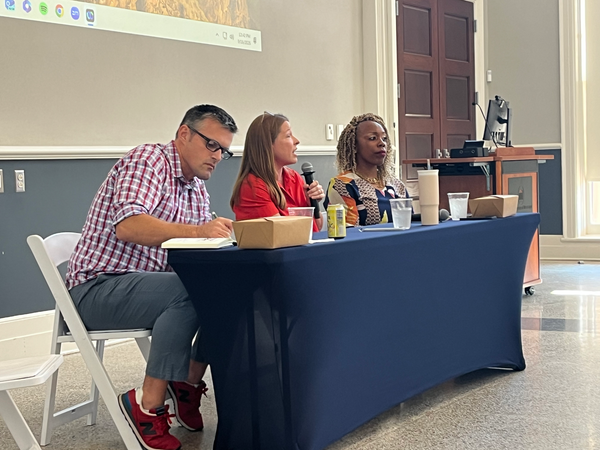
On Wednesday, September 30, CETL hosted a community conversation, “The Ethics of Using AI as Instructors,” with facilitators Emily Pitts Donahoe (CETL), Marc Watkins (Academic Innovations Group), and Danielle Clevenger (Center for Practical Ethics).
Emily kicked off this discussion-centered event with a brief look at the statistics of AI use among UM faculty. A recent faculty survey revealed that AI use for instructional work was somewhat more common than use in academic work, and also that approximately 37% of those who report using AI for instructional work do not disclose that to their students. We also saw that most faculty felt confident that they understood the ethical obligations/responsibilities of using AI in teaching while about 35% reported that they felt neutral or did not have a good understanding. About 19% of those surveyed about AI for instructional use had concerns about the accuracy of AI responses and another ~19% had concerns about intellectual property, equity, pedagogical responsibility, environmental impact, etc.
Emily then passed the microphone to Marc, who described some recent cases of AI being used in the classroom by instructors. He noted that, according to a report by Anthropic at least, many of the faculty who are using AI for grading are using it in an automation-heavy way. He also introduced the news of AI teaching agents being rolled out to save faculty time on “low-value tasks” and the recent case of an instructor who used AI to proctor and grade oral exams. Students often, he noted, have a problem with faculty use of AI, particularly when that use is not transparently disclosed. Finally, Marc shared a new probability model called Jev and showed how it could be used to automate days’ worth of grading quickly, and for only a few cents.
Marc’s brief talk raised the worrisome possibility of a classroom where bots teach bots, and no one learns a thing – a very detrimental outcome for our students. The question is, should we use these powerful tools as instructors and, if so, how can we employ them to assist our students’ learning in the best way possible? As Marc mentions in his TEDx talk, the perceived need for “efficiency” has driven many to offload their judgment to these systems, when instead we should be using them to augment our skills and discover our creative potential.
Marc’s short talk led into the discussion portion of the session, where groups seated at each table considered case studies of instructors using AI in various ways. During the debrief, participants raised a number of interesting points:
Transparency and trust were the biggest themes in this conversation about AI. Teachers and students alike should practice honesty and disclose when using AI in their work. Participants also noted the importance of accountability among teachers and students, particularly since an AI model bears no conscience and thus cannot bear accountability, and reciprocity in teacher and student expectations. The discussion uncovered a number of ways in which undisclosed or unfair use of AI might negatively impact the relationship between instructor and student.
Some participants felt that instructors’ use of AI in teaching came down to self-preservation. In a context where faculty burnout is so prevalent, using AI ensures things get done quickly, allowing instructors to maintain both their sanity and their jobs. But many tables also expressed concerns about outsourcing of critical thinking to AI models and thus a decline in ability amongst both instructors and students.
At my own discussion table, we talked about how AI might be used to handle time-consuming tasks such as making Excel spreadsheets and designing slides while leaving the higher-order thinking to the instructors and students. This, of course, requires us to distinguish what counts as higher-order thinking, but there was high confidence that this distinction could be made.
We also discussed the important question of who will police the use of AI among instructors. This surfaced from one of our case studies, where an instructor who disclosed their AI use via a statement in their syllabus found that one of their students had relied a bit too heavily on AI in their own coursework. The student justified it by claiming they had used AI in the same manner as the instructor did. So, the question is, will this same faculty determine how AI should be used by both students and instructor? And in that case, how will we ensure the faculty member is not overrelying on AI either? Should a separate entity be in charge of AI use regulations?
After discussion of the case studies, facilitators closed the session by asking participants to consider their “duty of care” in relation to AI. What is our responsibility to our students and ourselves? What values or principles should we use to guide our individual uses of AI? And what should guide department or university policy around AI use?
This technology is still new, and we are just at the beginning of considering its use and value for instructional work. The session may have raised more questions than answers, but we hope to continue the conversation in the coming months.
You can find the slides for the session here and case studies here. CETL only has two lunchtime workshops left for this semester: a session for Answering Your Most Pressing Disability/Accessibility Questions and a workshop on Effective and Compassionate Strategies for Low- (and No-) Tech Assessments. If you’re part of the UM teaching community, please register to join us!